
NISE-Stim therapy supports posture, mobility, and breathing in SMA

As 3-year-old Evie Bradford splashes in a shallow pool, her family cheers when she dog-paddles with all four limbs, her head bobbing above water. Less than a year ago, this little girl with spinal muscular atrophy (SMA) type 1 loved being in the water, but lay passively while someone held her, unable to flip over or swim on her own.
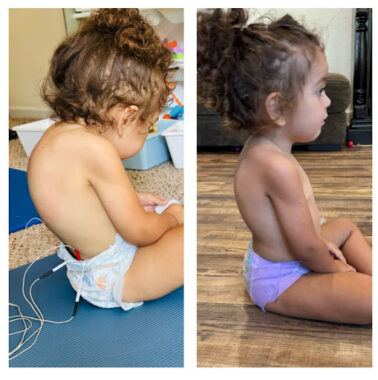
On land, gravity caused Evie’s body to carry the full weight of SMA. She couldn’t pull herself onto her feet. The weight of her head pulled her spine into a rounded back, a severe kyphosis that compressed her heart and lungs, making it harder to breathe.
The difference in Evie’s kyphosis and spine before starting NISE-Stim therapy (left), and after months of treatment. (Courtesy of Janet Bradford)
That changed when her parents, Janet and David Bradford, began using an innovative therapeutic approach called noninvasive spinal electrical stimulation, or NISE-Stim, to improve Evie’s strength by sparking intact nerves to activate muscles.
“NISE was just what we needed to complement everything else we were doing,” Janet says, adding that Evie takes a daily disease-modifying medication for SMA and received a one-time genetic therapy at 6 weeks of age.
Today, after daily NISE-Stim therapy since May 2025, Evie’s spine has straightened dramatically. Her SMA care team marveled at the progress when her parents shared it during a late-2025 checkup.
“All [of her doctors] are over the moon at her progress. We saw her ortho, and he said Evie is completely off the spinal rod surgery path now,” Janet says.
First use of this technology in SMA
Referring to herself as a dedicated researcher of healthcare treatments, Janet initially came across a video showing spinal electrical stimulation used to improve the trunk strength of a child with spina bifida.
That led her to Gerti Motavalli, a Florida-based physical therapist who had already treated more than 400 children with spina bifida.
With 41 years in pediatric therapy, much of it stateside after training in Germany, Motavalli co-developed NISE-Stim in 2017 with Gad Alon, PhD, a researcher in the field of electrical stimulation. Her success in treating spina bifida grew from there, and it wasn’t long afterward that a London colleague adapted it for SMA.
“Andrea Herciu used my treatment and adjusted it for children with SMA and had incredible results,” Motavalli says. “Andrea shared her findings, and I started treating children with SMA, and it’s been inspiring. Within weeks, you can see changes.”
Evie became Motavalli’s first SMA patient and has since ignited weekly inquiries from families of children with the disease.
Motavalli now guides therapy for more than 30 young SMA patients. However, Motavalli is clear that it is not a fit for every child. Children who don’t receive genetic treatment for SMA are not candidates for spinal stimulation, she says.
Children who have already had spinal surgery also need a different approach, as she avoids placing electrodes directly over areas where rods are in place.
Bridging SMA’s nerve gap
NISE-Stim focuses on improving the severed communication between nerves and muscles to boost muscle strength and function in people living with SMA.
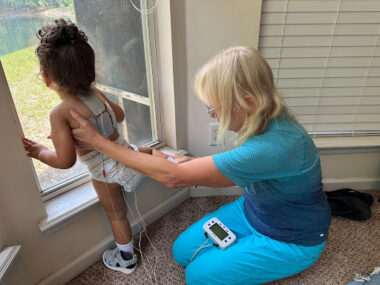
Evie moves around while Gerti Motavalli places the NISE-Stim electrode pads. (Courtesy of Janet Bradford and Gerti Motavalli)
“In SMA, the nerve cells in the spinal cord are damaged. There’s nothing wrong with the muscle itself. But … the nerve-muscle connection is greatly impaired, and when the muscles don’t get the signal to activate, they get progressively weaker,” Motavalli says.
During treatments, physical therapists or other trained specialists attach soft electrodes directly to the skin along the spine where damaged nerve cells are and at targeted hotspots, such as a kyphosis curve or the gluteal muscles, to stabilize unsteady hips.
The electrodes send mild impulses that activate the muscles, prompting natural contractions, much like a controlled set of weightlifting repetitions.
“The electrical stimulation is activating the spinal nerves. As that’s the connection that is missing, I think that’s why the success is so much better than other physical therapy that tries to activate the muscles,” Motavalli says.
From movement to breathing and beyond
Beyond movement, NISE-Stim activates breathing muscles, including the diaphragm, supporting deeper breathing, more effective coughing, and fewer respiratory infections.
Those same spinal pathways also link to the digestive system. Evie lives with gastroparesis, a condition in which the stomach takes too long to empty out food, but Motavalli says Janet has been able to cut back on medication because the therapy is stimulating Evie’s gastrointestinal tract.
Home therapy sessions
While therapy is initially provided by trained professionals, NISE-Stim therapy may later begin at home after parents share videos and X-rays of their child’s posture.
Motavalli guides each family through a three-hour training session to teach them how to use the technology at home. When possible, she also trains a nearby physical therapist, so the family has local support.
The machines are straightforward, from a basic $80 model to a $400 upgrade that facilitates remote monitoring. Ongoing costs are replaceable electrodes at $10 to $20 monthly, each handling 10 to 15 uses.
Follow-up appointments are every two weeks, done in person or virtually, and then are spaced out as progress is made.
Posture and motor breakthroughs
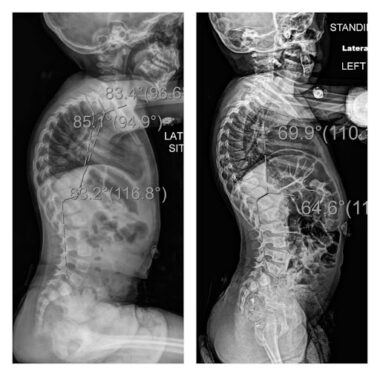
X-rays show Evie’s spine in May 2025 (left) and October 2025. (Courtesy of Janet Bradford)
Before Janet’s daily use of NISE-stim, Evie’s kyphosis had hunched her like “an old person,” pressing her lungs and risking early spinal surgery.
Within one month of starting the therapy last year, Evie could crawl with her head lifted against gravity. Soon she could pull herself to standing, flip over in a swimming pool, and reach doorknobs.
“She couldn’t raise her right arm above her head. That girl is walking and opening doors now,” Janet says with pride in her toddler’s achievements.
Spreading hope to SMA families
Janet’s updates on Evie’s gains have rippled far beyond Oklahoma.
Messages have flooded in from parents in Armenia, India, Spain, and beyond, drawn to social media photos of Evie’s straightened spine and skills that exceed typical SMA expectations.
Janet fields their questions but always points to qualified therapists, as detailed knowledge about how to program the stimulator and where to place the electrodes is essential.
“Please contact a therapist in your area who does it, if you’re interested,” she advises, noting Motavalli maintains a list of NISE-Stim therapists around the world.
The post NISE-Stim therapy supports posture, mobility, and breathing in SMA appeared first on SMA News Today.